Video Screening of I am Not Your Negro will be on July 26 from 4:30-6:30 at 4951 Walnut St
More info here: https://www.facebook.com/events/568101090246911/permalink/572113786512308/
A space to share notes, information, and lessons across issues and books for this summer's social justice book clubs.
Thursday, July 20, 2017
Discipline Over Punishment, Update & Next Meeting Tomorrow!
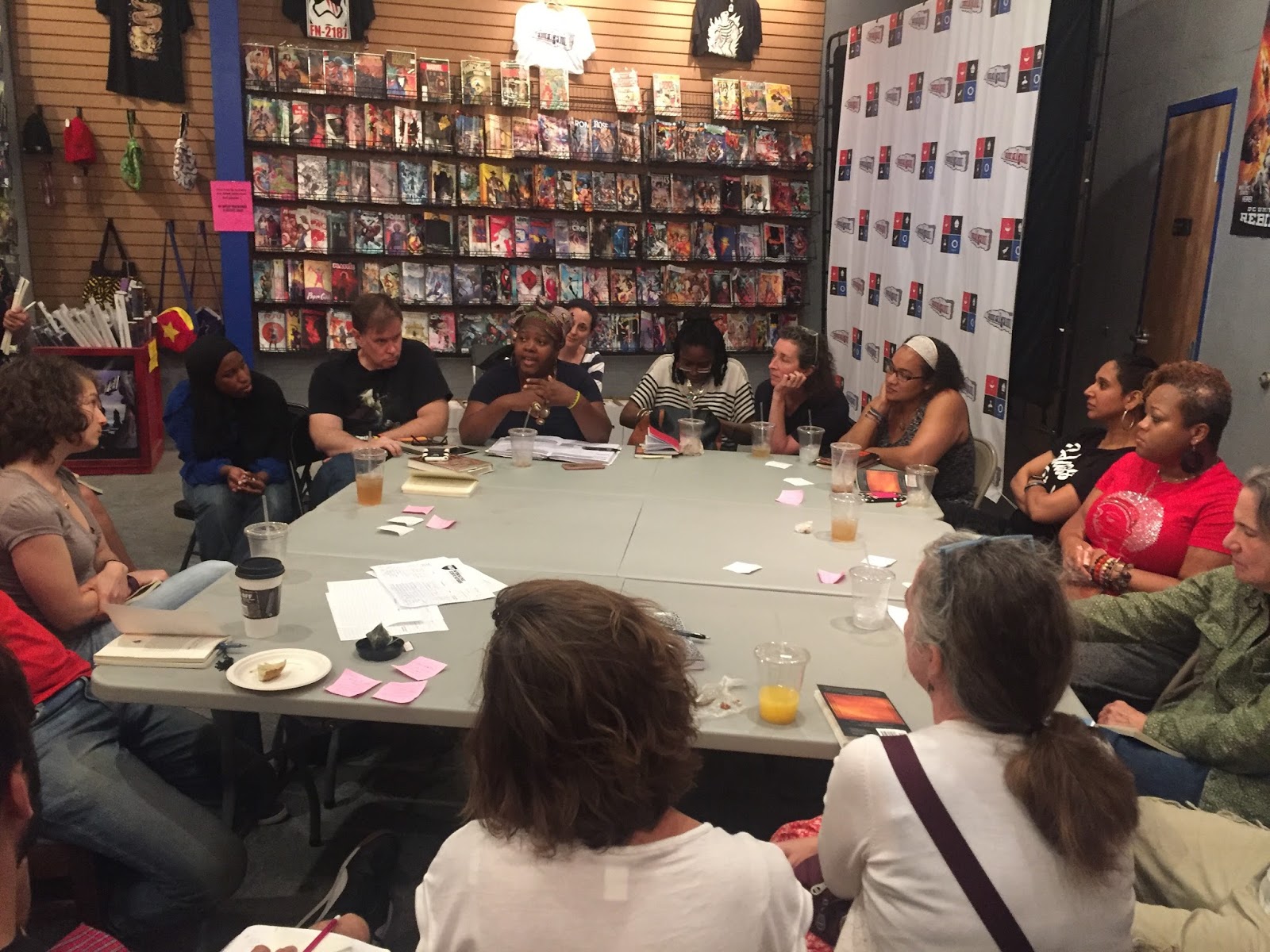
We are meeting tomorrow Thursday, July 20th from 4-6 pm at One PA, 5027 Baltimore Ave
We had a great conversation and a lot of interesting ideas raised. We look forward to delving even deeper this week.
We will be discussing Chapters 3-5. Below are some discussion questions we will use to start off the conversation:
How does our education system set us up to reinforce putative/oppressive systems?
How can we build community and relationships to engage the creative maladjustment (definition on page 41) and righteous indignation we encounter in our students?
What are some successful relationship building models or techniques you have used to lay the groundwork for strong community?
What opportunities and challenges do you see in the Students Justice Panel? How could the model relate to your own setting?
Looking forward to seeing you tomorrow!
Tamara and Kendra
Wednesday, July 19, 2017
No Shortcuts, Meeting Update
About 25 people met on Monday to discuss Jane McAlevey’s book No Shortcuts. There were organizers affiliated with a wide range of organizations, along with many WE and PFT members. McAlevy’s book told several stories of successful social movement labor organizing. Two stories that we found particularly instructive were the Chicago Teachers Union strike of 2012 and the Smithfield Foods contract campaign in North Carolina.
From the CTU Strike, there was some energy around the question: How can non-teachers and community members be brought into the organizing? McAlevey critiques Alinsky-style community organizing, yet strong community organizing is what contributed to the CTU win. Does Philadelphia have deep enough neighborhood community organizing to support a teacher strike? How can Philly move in this direction? It helped that everyone hated Rahm Emanuel in Chicago. If you wanted to stick it to Emanuel, you should support the teachers. We don’t have that kind of mayor.
We were also inspired by the successful Smithfield Foods strike against all odds in the South. It’s such an important story, one that needs to be told, but there’s a gag order so the story can’t be public. Workers NEED success stories in these times.
We discussed how relationships are crucial to organizing (as opposed to mobilizing), which includes honest conversations about how bad things are and honesty about the struggle ahead. Struggling together makes relationships and organizations stronger. And not just any struggle: class struggle, where workers are in a prolonged push-and-pull with owners. There may not be a win if you try, but there will definitely NOT be a win if you don’t try! Someone noted how there were several points in some of the labor organizing stories in which the union could have backed off or gone harder, and it was inspiring to see them make the choice take risks and go for it.
The philosophy of a democratic union is just different, and not something people are used to. In the current PFT, people don’t tend to feel a sense of their own power and agency, but there is lots of potential at the building-level. A well-run building committee can make a lot of difference. Where the traditional structures feel like an obstacle to progress, groups of teachers can start by gathering together around making their school better, making a series of small improvements together, and eventually decide to call that “union work.”
This post was written by: Dave Backer and Kathleen Riley
NOTE THE TIME CHANGE: We’ll be meeting Monday, July 31st from 7-8:30pm to talk about Direct Action by L.A. Kauffman. Join us at 441 W. Earlham Terrace 19144.
Other People's Children, by Lisa Delpit
On Tuesday, July 11th, we held our first meeting to discuss Other People’s Children by Lisa Delpit. While the sections we read were originally published three decades ago, Delpit’s themes and concerns still resonate for many of us. We started by reflecting on why it can be difficult to talk about race, and why it’s important, especially as educators, to engage in this discussion. From there, our conversation touched on power dynamics in the classroom, teaching skills verses teaching process, and the different implications of more authoritative classroom management styles and flexible, student-centered approaches.
We wrapped up our conversation with lots of questions. How can our instruction both help students develop skills to access the language of power and also strengthen critical thinking skills so they are prepared to challenge it? How can you run a democratic, student-centered classroom that challenges students and teaches them concrete skills? How can we create space to have these discussions with other colleagues?
We’ll be meeting Tuesday, July 18th to keep the conversation going. Join us at the A-Space, 4722 Baltimore Ave, at 4:00.
Class War: The Privitization of Childhood, Meeting 1
Here is a re-cap of our first meeting:
The next meeting will be on July 26 from 7-8:30pm at 814 S. Sheridan St
The first meeting of Class War was excellent! We touched on major themes of individualism versus collectivism in education; how schools perpetuate inequality—but are not the only mechanisms to do so; and how childhood became swindled and privatized through baseless fear-mongering and bipartisan legislation, and how in many ways this privatization hurts all of us—teachers and students, working class and middle class, and black and white. The privatization (or denial) of childhood comes at the detriment to everyone, but more clearly hurts and hinders historically marginalized populations.
We discussed the racialized and class dynamics of schools, drawing from our collective experiences in charter schools, traditional public schools, magnet schools, and the most bourgeois private schools. In so doing, we discussed how geography, city policy, and non-profits have shaped these experiences. We discussed the tension and anxiety that surround questions of school choice, and this NYT Magazine article was brought up as an example of how we all want to see the best for our children, but it is not always clear on how to reconcile that with our progressive missions to want the best for other people’s children and communities. Further suggested reading is Marketing Cities, Marketing Schools which is focused on Philadelphia and the Center City Schools Initiative.
Tuesday, July 11, 2017
Undocumented: How Immigration became Illegal, Meeting 2
The book group reading Undocumented: How Immigration became Illegal has been identifying themes found in the book and unpacking those themes and applying them to present day.
Some things we have discussed include:
- The use of the law by those in power to develop, maintain, and enforce unjust social and economic structures
- The inherent contradictions in the immigration issue in the US:
- On the one hand the economy relies on very low wage workers like immigrants, but on the other these workers are criminalized because of how they arrived
- The US claims to be a nation of immigrants but has demonstrated hyper-xenophobia over the last 150 years
- For people from the US and Europe, freedom to travel is considered a birth right but freedom to travel does not apply to others
- The United States government demanded that US citizens in China be subject to US law, instead of local law
- Migration to the US has not really changed. What has changed are the laws;
- “Illegality is a way to enforce a dual labor market and keep some labor cheap, in a supposedly postracial era. Illegality uses lack of citizenship – that is, being born in the wrong place – to make workers more exploitable” (P. 39)
- The cruelty of US policy across centuries: the treatment of Chinese and Filipino immigrants who built the railroads that produced incredible wealth for this country but who were then tossed aside; the use and abuse of Mexican migrants who engaged in circular migration to come to work in agriculture and who were lynched by the Texas Rangers (after whom we have named a baseball team); and the current policy of the Border Patrol to not search for migrants at the border but to wait until they are dehydrated and starving in the desert so that it will be easier to deport them are just some examples;
- The role of hegemony in getting people to buy into the myth that immigrants are causing problems and that “our” ancestors immigrated “legally” when so-called illegal immigration did not exist until 1965. Chomsky notes that Europeans ‘have used religion, race, and nationality – that is, countries and citizenship – as organizing principles to divide people into categories and castes. Each has been used hierarchically to justify social inequalities and differential legal treatment of different groups. Once status is inscribed in the law, this becomes an automatic justification for inequality: “It’s the law!”’ (p. 24).
- The use of laws to justify covert racism. As with Blacks, criminalization could no longer happen because of race so immigrants of color were criminalized for their status (p. 15) and special laws were developed for them, not unlike the Rockefeller laws
- The use of law, and the internalization of believing that law is good, makes the process of dehumanization easier
- Immigration is the flipside of inequality
The third meeting will be on Thursday, July 13 from 3:30-5:00 in Center City. Location TBD
Friday, July 7, 2017
The Underground Railroad, Meeting 1
Here's a look into the first meeting for The Underground Railroad.
The second meeting will be on Thursday, July 27 from 5:30-7:00 at 2578 Frankford Ave.
Subscribe to:
Posts (Atom)