Monday, August 13, 2018

From the Notebooks of Melanin Sun - Looking Forward

By Hetali Lodaya

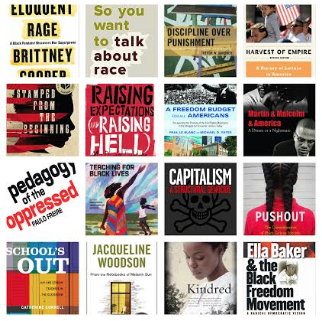
The School's Out reading group spent our last session talking about the short book From the Notebooks of Melanin Sun by Jacqueline Woodson. The book takes us through Melanin's journey as he processes new information about his mother's sexuality, and considers what that means (or doesn't mean) about him as a person and about their family unit. We all felt that the portrayal of Melanin was pretty accurate - he had so many of the responses that we could imagine a middle school student having to these events! Additionally, he finds it hard to disconnect his mother's identity from his own - this is the first time he's realizing, perhaps, that there are things about her that don't directly involve him, and vice versa.

The book started a great conversation about action steps that WE Caucus members might be able to take to amplify the issues we discussed all summer within the school district. From direct advocacy at school board meetings to more trainings around existing platforms like Policy 252, there are a lot of positive steps that group members plan to take in the coming months! This was a wonderful reading group to be able to join and I am so grateful to all the members of School's Out for being willing to share their perspectives and their stories.

Hetali Lodaya is a legal intern at Education Law Center and a student at the University of Michigan Law School.


Book group members discuss action steps they can collectively
take during the 2018-2019 school year.

Friday, July 20, 2018

School's Out - Understanding Queerness in the Classroom and Out

by Jeni Mattingly

as a bike mechanic who is curious about how queerness exists in professional settings, this group has been a fun way to interact with an otherwise dully written book about the unique professional challenges faced by queer teachers. at our last meeting folks shared personal stories about being out at school and what it was like to be an LGBTQ student, which led to a discussion about policy 252 - a set of guidelines for creating a supportive environment for transgender and gender non-conforming students (arguably, all students). it was exciting to see the group come up with action steps to help implement this legislation: more proactive training, community-building, and a shift in classroom habits - one person suggested organizing the students by height rather than gender. 

it will be exciting to see these action steps take shape in the last two meetings of our group, and i am eager to continue connecting an academic book to real-world experiences of educators in our community. 

jeni works at fairmount bicycles where she spends some of her time ranting to delightful customers about "men's" and "women's" helmets (what size is your head! what colors do you like! why is the industry doing this to us!) and other pointlessly gendered products.

Facilitator's Note: We keep forgetting to take pictures during our meetings (the discussions are just too good!), but here are co-facilitator Maddie's cats, Pío and Pasta, helping prepare meeting notes. 


Wednesday, July 18, 2018

Capitalism: A Structural Genocide 2


One last blog to tie together the Capitalism: A structural Genocide Summer Reading Group. If you could not make, no worries. The book will still be waiting for you. 

We had an engaging final discussion of the book and some of the issues that it raises.  
  • we began with a discussion of respectability politics and how this permeates our lives in many different spheres.  How this reduces us to consumers and measures our worth in relation to the market.  We talked about how this imposes itself upon us and defines us in certain ways that are limiting; how it also tells us how to dress and what to buy; how it reproduces "civility"; and how it even creeps into the classroom through certain over-policing strategies under the guise of classroom management. And, we thought about the ways this thinking is inculcated in each of us and what that might mean for us as educators in different settings.
  • we then discusses how our schools might reproduce unhealthy hierarchies that further internalize oppression. In the book Leech titles one of the chapters "Legitimizing the Illegitimate." He discusses coercion and hegemony using the work of Antonio Gramsci. Some of the things discussed from Gramsci include how ruling elites gain and maintain consent by utilizing various methods to socialize the masses and how civil society - the media, educational system, religion, and culture - serve to socialize people into thinking that capitalism is the only way. The school system fits in because by and large schools instill in children the values preferred by capital. Students are taught from a young age to compete with one another, to accept hierarchy without questioning, and about conformity through testing. The media then reinforces those values.
  • We also discussed how schools often prepare students to maintain their place in society. 
  • Education is often seen as a "get out of poverty" ticket. If you do the right things, work hard, go to college, you should be able to make it. But people are still not making it and the odds  are still against the majority.  This causes psychological trauma. People have been socialized into believing in the myth of meritocracy so when they cannot get ahead, they blame it on themselves, just as society has taught them to do. This is called second order blaming.  And this is capitalism
  • One quotation from p. 104 - "The hegemonic discourse, in part through the philanthropic endeavors of capital, also seeks to socialize people into believing capitalism is a humane social system that provides opportunities for individuals who are willing to work hard." This led to some discussion of the Non-Profit Industrial Complex (some resources below). 
  • The book discusses environmental issues and we brought up how in order to survive, capitalism needs growth. That growth is based on the extraction, use and abuse of limited natural resources, therefore capitalism is not sustainable for any life on the planet.
·       ·      “The logic of capital is blind to the ecological crisis that has resulted from its constant expansion in pursuit of profit because it is solely focused on accumulation. And in order to accumulate, capital requires constant economic growth” (p. 85)
·      Vandana Shiva – “the growth of the market cannot solve the very crisis it creates”  (p. 86).

  • One member of the group brought up the work of Robin D.G. Kelley, particularly his book Freedom Dreams: The Black Radical Imagination. Kelley talks about how we must use our imagination to create something new, but capitalism does not allow us to do this. It constrains us and punishes us if we imagine alternatives. (See the short video from the pervious synopsis of our discussion - Capitalism is Just a Story - https://www.filmsforaction.org/watch/capitalism-is-just-a-story-rise-up-and-create-a-new-one/)
  • We discussed alternatives to capitalism including socialism and cooperative systems like Mondragón in the Basque Region of Spain and Emilia Romagna in Italy which began in the 1860's 
·       ·      “Socialism is based on a simple idea – that the resources of society be used to meet people’s needs, n other words, at the heart of socialism is the impulse to further the development of all people in a sustainable manner” (p. 112).

  • We talked about how it is important to both think about how we can survive more humanely now while we create alternatives. We need to continue to expand out knowledge by reading alternative sources and that we need to commit to working collectively for change
  • Wee need to create systems that are less-exclusionary and more participatory and that do not use language that is alienating and academic. we can do this through]
·       ·      everyday life encounters (Jane Addams)
·       ·      building and nurturing relationships
·       ·      using existing resources like MLK speeches, Angela Davis, and others to spark conversation
·       these can all provide people with a vocabulary to help make sense of the world and then to act to make change.
I hope the rest of your summer goes well. 

Rosi Barbera

Some Resources

·       •Ballard., N. (2009).  To Live Well.  In D. Ransom & V. Baird (Eds). People first economics (pp 153-164). Oxford: New Internationalist Publishing.
·       •Berry, W. (2009).  Inverting the Economic Order. The Progressive, 73(9), pp. 18  – 25). Beacon Press.
·       Chadburn, M. (2015). Resilience is Futile: How Well-Meaning Non-Profits Perpetuate Poverty.  Retrieved from http://jezebel.com/resilience-is-futile-how-well-meaning-nonprofits-perpe-1716461384
·       Ciccierello-Mahr., G. Building the Commune
·       Collins, C. & Flannery, H. (2016) Gilded Giving: What happens when Billionaires Dominate the Charitable Sector. Retrieved from http://www.alternet.org/economy/billionaires-dominate-charity?akid=14904.17896.gZJOzq&rd=1&src=newsletter1067682&t=24
·       Davis, A. Y. (2016). Freedom is a constant struggle: Ferguson, Palestine, and the foundation of a movement (Chapter One).  Chicago: Haymarket Books.
·       Ho, H. K. (2017). 8 Ways People of Color are Tokenized in Nonprofits. Retrieved from: https://medium.com/@helenkimho/8-ways-people-of-color-are-tokenized-in-nonprofits-32138d0860c1
·       Kivel, P. (2000). Social Service or Social Justice. Retrieved from http://paulkivel.com/wp-content/uploads/2015/07/socialserviceorsocialchange.pdf
·       Le, V. (2015). Are you or your org guilty of Trickle-Down Community Engagement? Retriefved from: http://nonprofitwithballs.com/2015/01/are-you-or-your-org-guilty-of-trickle-down-community-engagement/
·       Kelley, R. D. G. (2003). Freedom dreams: The Black radical imagination.
·       •Miller, E. (2009). Solidarity Economy:  Key concepts and Issues. In E. Kawano, T. N. Masterson & J. Teller-Elsberg (Eds.). Solidarity economy 1: Building alternatives for people and planet (pp. 24 – 41). Amherst: Center of Popular Economics.
·       Nixon, R. (2011). Slow Violence and the environmentalism of the poor. Harvard Press.
·       •Ostrom, E. (2010). Eight Principles for Managing the Commons. In J. Walljasper (Ed.). All that we share:  A field guide to the Commons (p. 22). New York: The New Press.
·       •Restakis, J.  (2010: Humanizing the economy:  Co-operatives in the age of capital. British Columbia: New Society Publishers.
·       •Sitrin, M. (2006). Horizontalism: Voices of popular power in Argentina.  Oakland: AK Press.
·       •Wall, D. (2009). Open Source Anti-Capitalism. In D. Ransom & V. Baird (Eds). People first economics (pp 181-192). Oxford: New Internationalist Publishing.
·       •Walljasper, J. (2010). All that we share:  A field guide to the Commons. New York: The New Press.
·       •Wolff, R. (2012a).  Democracy at work:  A cure for capitalism.  Chicago: Haymarket Books.
•Wolff, R. (2012b, June 24).  Yes, there is an alternative to capitalism.  Mondragon shows the way.  The Guardian.  Retrieved from http://www.guardian.co.uk/commentisfree/2012/jun/24/alternative-capitalism-mondragon

Tuesday, July 17, 2018

Capitalism: A Structural Genocide


Last week we looked at how capitalism and the market are insidious in that they creep into every aspect of our lives and control much or what we are able to do and not do. Some things that came up:
- the system is not broken; it is doing exactly what it has been designed to do. Vandana Shiva's quotation on p. 29 captures that - "The poor are not those who have been left behind; they are the ones who have been robbed."
- there is a direct connection between how capitalism functions and the condition of our schools; and,
- capitalism needs growth in order to function, but with that growth comes destruction.

Here are some resources that might be helpful:
- The documentary The End of Poverty (not to be confused with Jeffrey Sachs book by the same name. The book basically is a cheerleader for capitalism, the documentary is not);
- the documentary The Economics of Happiness;
- some shorts at filmsforaction.org:

Monday, July 16, 2018

Discussing Pushout: the Criminalization of Black Girls in Schools


By Rebecca Coven

On Tuesday, July 10, the Future of Our Schools book group had our first meeting to discuss Pushout by Monique Morris. Morris begins her book by recognizing that when it comes to media coverage of issues surrounding police brutality and the Black Lives Matter movement, we tend to focus on the plight of Black boys. However, less attention is given to Black girls who often need support just as much as boys. Our discussion of Pushout forced us to not only consider how we can support Black girls, but to also question how institutions that we participate in (primarily schools or other educational settings) are “dominant structures” that perpetuate racial and gender hierarchies. We began our discussion by interrogating the ideology that middle-class, heterosexual, White femininity is normative, which renders Black femininity as a subordinated gender identity (not just to White women, but to all men as well). When Black girls express anger or frustration (emotions that don't fit with the passivity of idealized White femininity), they are often seen as disrespectful or out-of-line. We want to make room for the Black girls in our schools to express themselves and to be themselves, and this book helped us to think through how we might do that.

In her book, Morris urges readers to consider the following questions: (1) What assumptions are being made about the conditions of Black girls? (2) How might Black girls be uniquely impacted by school and other disciplinary policies? (3) How are organizations, systems, and policies creating an environment that is conducive and not conducive to the healthy development of Black girls? Using what we learned from Morris’s book, as well as our own experiences working in educational settings, we tackled these important questions during our discussion.

Personally, the discussion helped me reevaluate my own teaching practice and the assumptions I make about my Black female students. Often I assume that my female students are more responsible and more mature than my male students, and so I expect more of them when it comes to maturity and responsibility. If there is any playing or an argument among a group of students, I often ask my female students to “be the bigger person.” However, this removes blame from the male students and invalidates the female students’ feelings and experiences. It perpetuates the idea that Black girls’ well-being comes secondary to others’ - particularly to Black males’ (an idea that Morris argues Black girls internalize at a very young age). We need to do a better job of protecting Black female students. We need to focus on how to make our Black girls feel safe - both emotionally and physically - in schools. 

We concluded our discussion by sharing ideas for resources or changes that we would like to see in our schools or in the district in order to better support Black girls. Ideas included:
  • Training for school staff on how to recognize girls in crisis and how to support them; regular, continued workshops on this topic.
  • Pushing for the recruitment and hiring of more Black female educators, as well as creating pathways for Black female staff members (who are not currently teachers) to become teachers.
  • Mentorship (particularly near-peer mentors) programs for Black girls; access to female empowerment/female leadership programs outside of school.
  • Having spaces for educators and students to learn about issues surrounding gender justice together in order to create more trust.
  • Invest more money in staff, particularly in school counselors.
  • Our work should not just focus on empowering Black girls and helping them build leadership skills, but should also include education of male students about gender justice and how to treat girls.

A common theme throughout our discussion of how to support Black girls was restorative practices. We will further explore how to implement such practices during our next meeting on July 30, during which we will be discussing Discipline Over Punishment by Trevor W. Gardner. We will meet at the Workshop School (221 Hanson Street) at 3:30 pm. Join us!

Thursday, June 14, 2018

Welcome to the 5th Annual Summer Reading Series!


It’s time again for the annual Summer Reading Series! For the fifth summer in a row, the Reading Series will be a place to deepen our relationships with each other; expand our political analysis, and inform our organizing and teaching in the upcoming year.  Education justice advocates around the country are asking about our Reading Series, and many are building their own and Rethinking Schools magazine just featured an article about this work.

Don’t miss out on a great summer of reading, discussing, and learning.   

This year, based on survey results, WE and TAG are excited to announce 16+ book groups. The nominating process yielded an exciting mix of classics and new releases, with a range of genres represented including biographies, science fiction, and a YA novel!  Groups will focus on labor organizing; racial justice; immigration; LGBTQ+ topics; pedagogy; capitalism; and more.  

This summer, we continue the tradition of bringing together people from all walks of life and all parts of the city -- parents, teachers, nurses, counselors, activists, community members, students, and anyone else!  All are welcome!  Please sign up here using the registration form.

Want to learn more about past book clubs? Read this article on the Summer Reading Series in Perspectives on Urban Education by WE supporting member Kathleen Riley, or check out the latest issue of Rethinking Schools magazine.

Tuesday, August 8, 2017

Transformative Teachers, Final Meeting

Where are we going from here?

Being an educator in a new city is daunting. It is a challenge to navigate state and district systems, to connect with activist teachers, and to continue the work that was once begun halfway across the country. Being part of the Transformative Teachers group has reminded me of three things: 1) start with what you know in your heart is right; 2) remember your source of passion in the classroom; and 3) use and share your connections. So, where do I go from here? I start with social justice, I use poetry as a source of passion for both myself and my students, and I start connecting--both widely and wildly.

Knowing that many of my students are talented and bold spoken word artists, I signed my school up to be part of the Philadelphia Youth Poetry Movement’s (PYPM) slam league. I also know that many of my students are craving outlets for change…ways to change themselves, ways to change their families and communities, ways to change this beautifully crazy world. And this, this is precisely where I can leverage transformative teaching practices. In addition to utilizing social media and other means of connection to reach out to potential colleagues, networks, collaborations, I also plan to rely heavily on the ‘voice and storytelling’ domain of transformative teaching to support students in using their realities and experiences to enact change and create justice.

I hope to inspire my students to take their poetry from the stage to the recreation centers, boardrooms, and council meetings of their communities in order to address the socio-political issues they care so deeply and passionately about. Spoken word poetry is nothing new, but each and every one of my students’ voices is a new chance, a chance to not only have stories heard, but also to fulfill the innate need for people to speak up for themselves and attempt to right what they feel is wrong in our city. Who knows, maybe my students will create the next iteration of the guerilla poetry movement. We’ll see…my students will decide what they want to do with their words. Let’s all be ready to listen up!